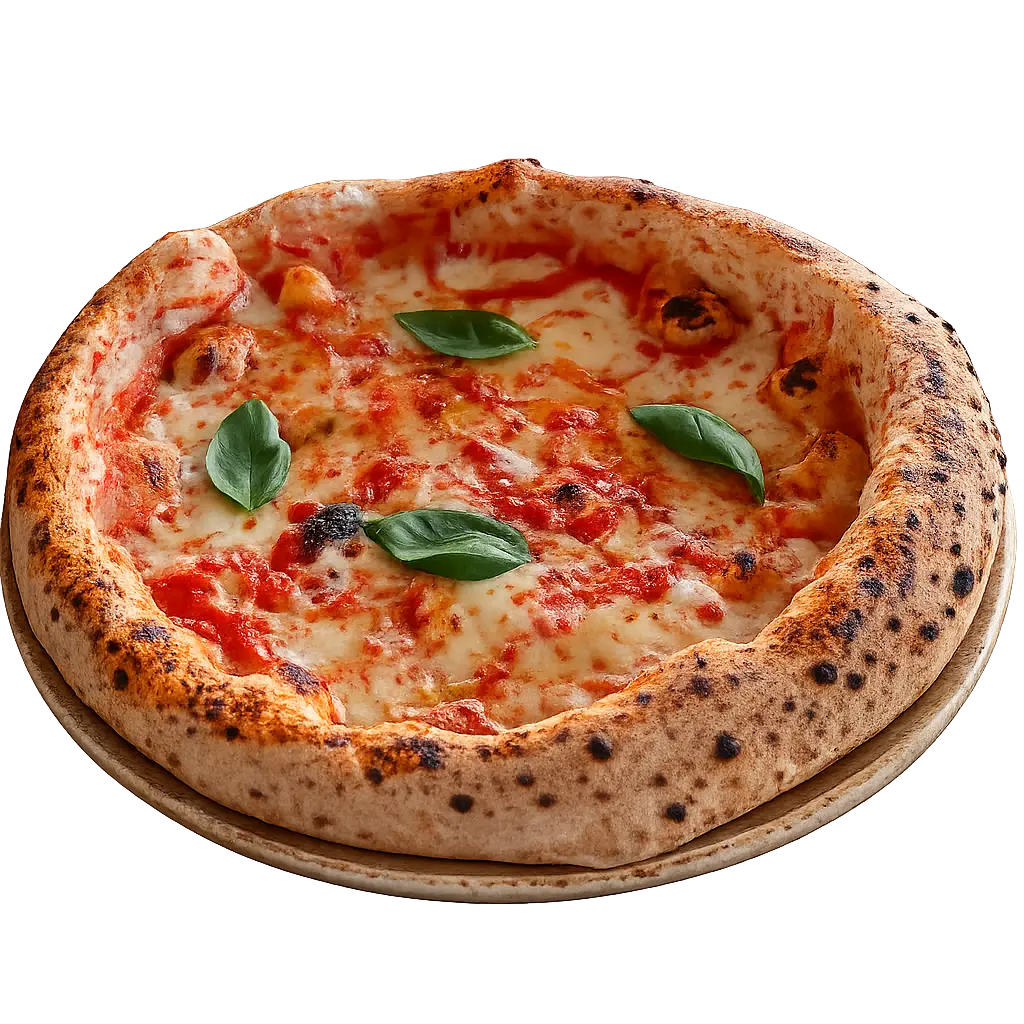
How to Stretch Pizza Dough
The fingertip press, the gravity stretch, and the habits that keep a Neapolitan base thin in the middle, puffed at the rim and free of holes — no rolling pin, ever.
In this guide
1. Before you touch the dough
Stretching is the last step of a long chain, and most stretching problems are actually fermentation problems. A ball that is properly proofed — soft, domed, slightly jiggly — almost opens itself. A ball that is cold or under-proofed fights you at every press.
Take the dough out of the fridge 2–4 hours before baking, depending on room temperature. It should feel like a relaxed muscle, not a cold stress ball. If you are unsure about timing, the cold ferment guide covers the schedules.
Set up before you start: a light dusting of semola on the bench, your sauce and toppings ready, and the oven fully preheated. Once a base is stretched it should be topped and baked within a couple of minutes, or it sticks.
2. The fingertip press
Tip the ball out of its container upside down onto the floured bench, so the smooth top becomes the bottom of the pizza. Do not tear it out — lift the container and let gravity release it.
With the pads of your fingers, press from the centre outwards, pushing the gas towards the edge. Leave a 1.5–2 cm border completely untouched: that ring of trapped gas is your cornicione, the puffed rim.
Flip the disc once, press again, and you should have a thick disc of 15–18 cm with a defined rim. Every press is away from the centre — never press the border down.
3. The gravity stretch
Pick the disc up and drape it over the backs of your hands, knuckles up. Rotate it a quarter turn at a time, letting the weight of the dough do the stretching. Your hands support and turn; gravity opens the base.
Keep the disc moving. If one spot is thinning faster than the rest, rotate past it and let a thicker section take the load. Aim for an even base of 28–32 cm from a 250 g ball.
If the dough resists and springs back, stop. Lay it down, wait two minutes, and let the gluten relax — then finish the stretch. Forcing tight dough is how holes happen.
4. The mistakes that ruin a base
- Stretching cold dough straight from the fridge — it tears and springs back.
- Using a rolling pin — it flattens the gas you spent days building into the rim.
- Pressing the border — a flat rim cannot puff, no matter how hot the oven is.
- Too much bench flour — it burns in a hot oven and leaves a raw, dusty taste.
- Letting a stretched base sit — the centre sweats, sticks to the peel and folds on launch.
- Topping with wet, undrained mozzarella — the centre goes soggy before the rim sets.
5. From peel to oven
Dust the peel lightly with semola, lay the stretched base on it, and give a small shake to confirm it slides. Top quickly and thinly — a Neapolitan base carries less than you think.
Launch with a confident forward-and-back jerk, and turn the pizza as it bakes. In a pizza oven at 430–480 °C that means 60–90 seconds; in a home oven on a preheated steel, 4–6 minutes on the top shelf. The home oven guide covers the adjustments.
If stretching is the step that keeps going wrong, the dough itself is usually the cause — the mixing, fermentation and balling decide how the base behaves. The full dough method walks through every stage before this one.
Frequently asked questions
Why does my pizza dough keep tearing when I stretch it?
Almost always the dough is too cold or under-rested. Cold gluten is tight and snaps instead of stretching. Let the dough ball sit at room temperature until it feels soft and relaxed, and handle it gently — extensibility comes from time, not force.
Can I use a rolling pin for pizza dough?
Not for Neapolitan pizza. A rolling pin crushes the gas bubbles that become the puffed, airy rim. Press and stretch by hand from the centre outwards, leaving the outer border untouched. For thin Roman-style bases a pin is acceptable, but the rim will be flat.
How big should I stretch a 250 g dough ball?
A 250 g ball opens to about 28–32 cm, which is the classic Neapolitan size. Stretch wider and the centre gets paper-thin and tears under toppings; smaller and the base eats thick and bready.
Should stretching flour be 00 or semola?
Semola rimacinata is the better bench flour: its coarse grains act like tiny ball bearings, so the dough slides instead of sticking, and it burns less in a hot oven. Use a light dusting — excess flour of any kind leaves a raw taste on the crust.
Stretching is the easy part — if the dough is right
The Secrets of Pizza eBook gives the tested dough method behind every easy stretch: biga ratios, fermentation timing and balling, step by step, for wood-fired and home ovens.
Get the Secrets of Pizza Guide — $29.99