
Homemade Pizza Crust Recipe: Easy Pizza Dough from Scratch
This homemade pizza crust recipe gives you two 12-inch crusts with a tender, airy interior and a golden, crisp exterior — using flour, water, yeast, salt and olive oil, a short rise and an ordinary home oven.
In this guide
- Why make homemade pizza crust
- Ingredients for homemade pizza crust
- How to make homemade pizza crust step by step
- Tips for the best pizza crust
- Thin, chewy, or thick crust?
- Best oven temperature for homemade pizza crust
- Common pizza dough problems
- Make-ahead, refrigeration, and freezing
- Ways to use homemade pizza dough
- FAQ

- Prep
- 20 min
- Rise
- 1 hr 45 min
- Bake
- 12–15 min
- Total
- about 2 hr 20 min
- Yield
- 2 × 12-in crusts
- Difficulty
- Easy
Why make homemade pizza crust
This homemade pizza crust recipe makes two 12-inch crusts from everyday ingredients in a little over two hours, most of which is hands-off rising time. It is written for a standard home oven and gives a soft, tender interior with a golden, crisp exterior.
Making the crust yourself means you choose the flour, control the thickness and taste real fermentation instead of a dry, pre-baked base. If you have never made pizza dough from scratch, each step below describes what the dough should look and feel like, so you can judge by sight and touch rather than by the clock alone.
Ingredients for homemade pizza crust
- Flour — builds the gluten that traps gas. Bread flour (about 12–13% protein) gives a chewier, sturdier crust; all-purpose flour (about 10–11%) gives a softer, more tender bite. More in the 00 flour guide.
- Yeast — instant or active dry both work at the same weight. Active dry yeast benefits from 5–10 minutes in the warm water first.
- Water — 65% of the flour weight, which keeps the dough soft but easy to handle. See pizza dough hydration for how this changes texture.
- Salt — seasons the crust and strengthens the gluten. Add it with the flour rather than directly onto the yeast.
- Olive oil — makes the dough more tender and easier to stretch, and helps the crust brown in a home oven.
- Sugar — optional. A small amount feeds the yeast and deepens colour at moderate oven temperatures.
- Cornmeal or semolina — only for the peel or pan, so the base slides and does not stick.
Substitutions: replace up to 25% of the flour with whole-wheat flour and add 1–2 tablespoons of extra water. Honey can replace the sugar. For a different batch size, use the pizza dough calculator.
How to make homemade pizza crust step by step
1. Measure and prepare
Weigh the ingredients if you can — a cup of flour can vary by 20 grams or more depending on how it is scooped. If using cups, spoon the flour into the cup and level it.
2. Combine the yeast
Stir the yeast and sugar into warm water around 38 °C / 100 °F. Instant yeast can be used straight away. Active dry yeast should look foamy after 5–10 minutes; if nothing happens, the yeast may be old.
3. Mix the dough
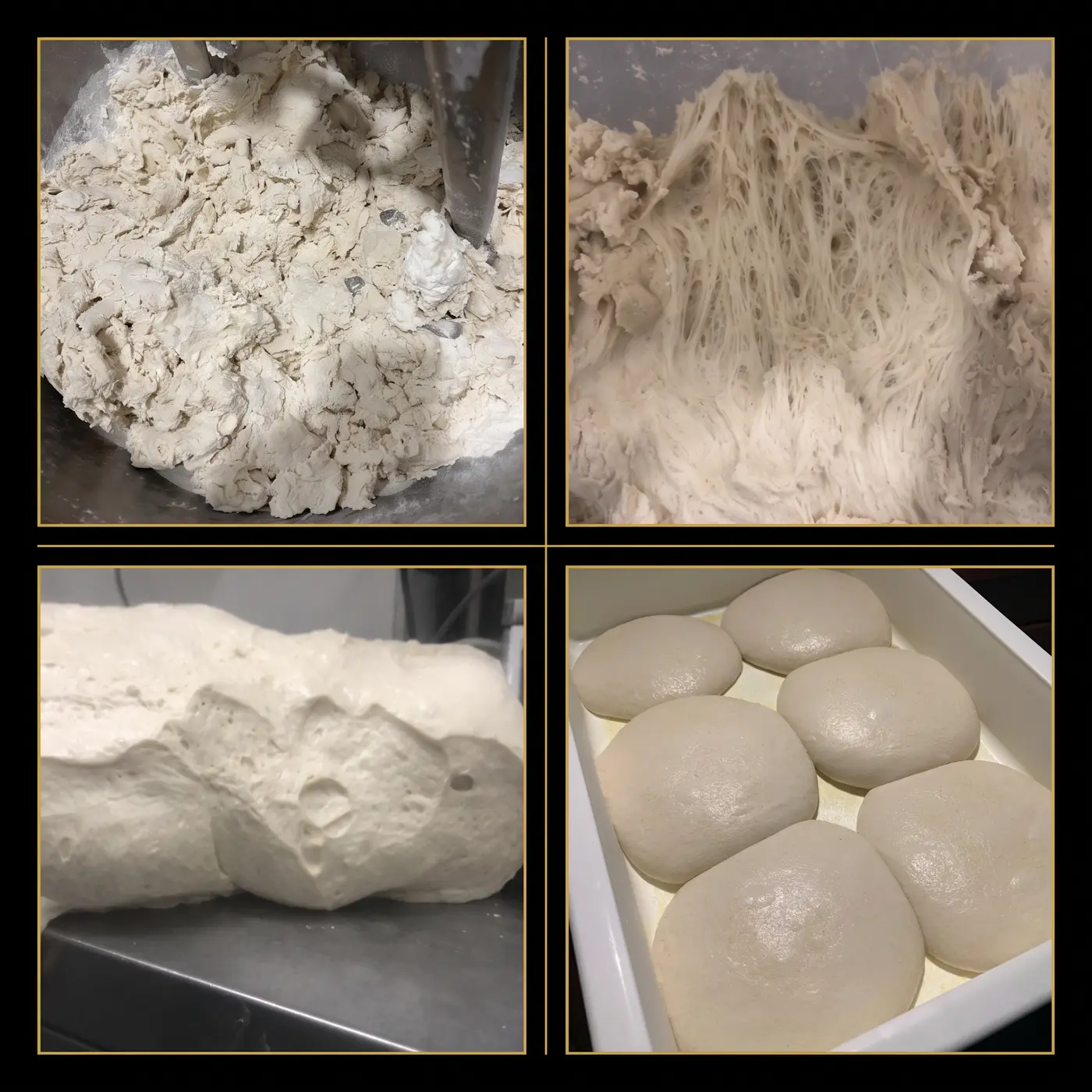
Add the flour, salt and olive oil. Stir until there is no dry flour and the dough forms a rough, shaggy mass. It will look lumpy at this stage — that is normal.
4. Knead
Knead on a lightly floured surface for 8–10 minutes. The dough starts sticky and uneven, then becomes smooth, elastic and slightly tacky. Press a finger in: it should spring back slowly.
5. Oil the bowl
Round the dough into a ball and place it in a lightly oiled bowl, turning it so the surface is coated. Cover with a lid or plastic wrap to stop a skin forming.
6. First rise
Leave it somewhere warm for 1 hour 15 minutes to 1 hour 30 minutes, until roughly doubled, domed and soft. A floured finger pressed in should leave a dent that fills back slowly.
7. Divide
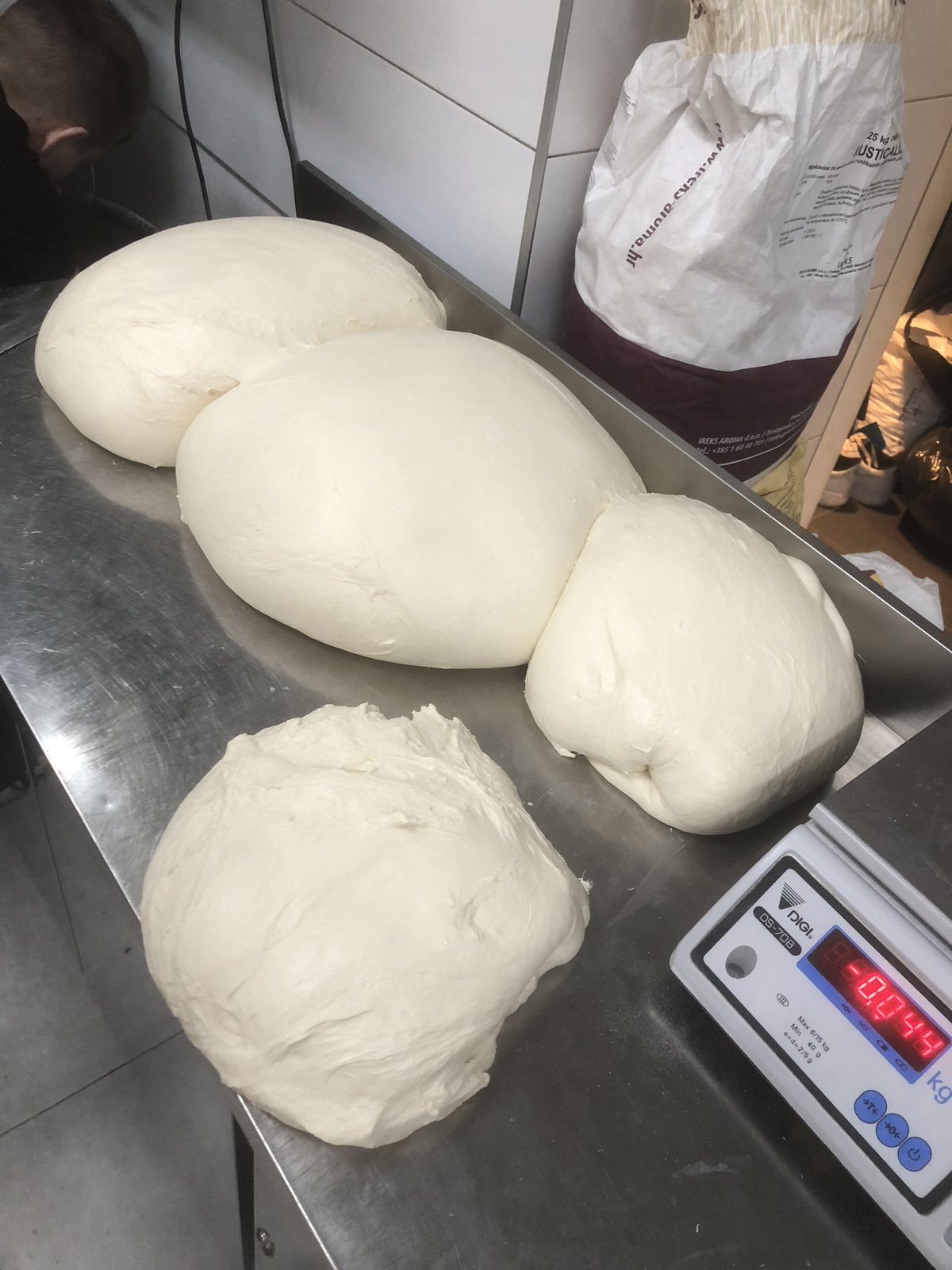
Turn the dough out and press out the largest bubbles. Divide into two pieces of about 430 g each.
8. Rest
Shape each piece into a smooth ball, cover and rest for 15 minutes. This short rest relaxes the gluten so the dough stretches instead of snapping back. Start preheating the oven now.
9. Stretch
Press from the centre outwards with your fingertips, leaving a 2 cm rim, then lift and stretch over your knuckles to about 30 cm / 12 inches. Avoid a rolling pin if you want a puffy edge. The stretching guide shows the technique in detail.
10. Top
Transfer the base to a peel or pan dusted with cornmeal or semolina. Spread a thin layer of sauce and add toppings in moderation — an overloaded base bakes unevenly and turns soggy. Try a simple marinara sauce.
11. Bake
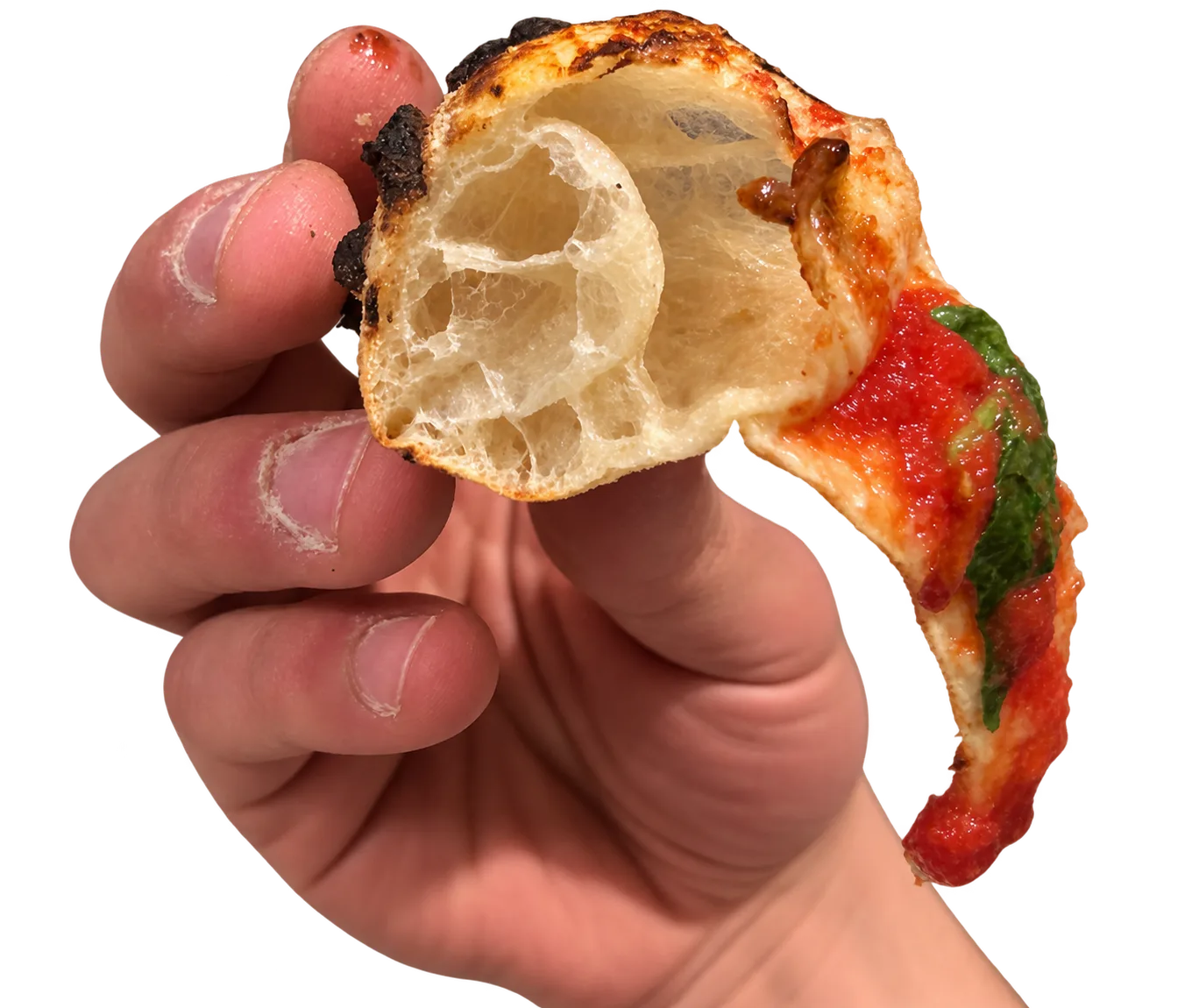
Slide onto a preheated stone or steel at 250 °C / 475–500 °F and bake for 12–15 minutes, until the rim is golden and the underside has brown spots. On a baking sheet allow 14–18 minutes.
12. Rest and slice
Let the pizza rest for 2–3 minutes on a rack or board before slicing, so the cheese sets and steam does not soften the base.
Tips for the best pizza crust
- Measure flour accurately — too much flour is the most common cause of a tough, dry crust.
- Water temperature matters: cold water slows the yeast; water above about 50 °C / 120 °F can damage it.
- Properly kneaded dough is smooth and stretches thin enough to let light through before tearing.
- Longer fermentation develops more flavour and a lighter texture; rushing the rise gives a bland, dense crust.
- Avoid tough dough by not adding extra flour while kneading and by letting the dough rest before stretching.
- Stretch with fingertips and knuckles, not nails, and let tight dough rest for a few minutes rather than forcing it.
- Preheat the oven and baking surface for at least 45 minutes; a hot surface is what sets and crisps the base.
- Prevent a soggy middle with a thin sauce layer, drained mozzarella and pre-cooked watery vegetables.
- For a crisper base, bake on a steel and finish with 1 minute under the broiler if the top needs colour.
Thin, chewy, or thick crust?
The same dough can lean in different directions, though it will not exactly reproduce every regional style. Thin crust: divide into three pieces instead of two, stretch to the edge with almost no rim and bake on a steel. Chewy crust: use bread flour and give the dough a cold rest in the fridge for 24 hours. Thick crust: press one 430 g piece into an oiled 23 cm / 9-inch pan, let it rise for another 30 minutes and bake a few minutes longer.
Equipment changes the result as much as the dough: a steel gives the crispest, fastest bake, a stone is slightly gentler, and a pan or sheet gives a softer, more bread-like base.
Best oven temperature for homemade pizza crust
High heat bakes the crust quickly so the outside crisps before the inside dries out. Most home ovens reach 250–260 °C / 475–500 °F, which suits this recipe.
- Pizza stone: preheat 45–60 minutes on a middle-upper shelf; bake 12–15 minutes.
- Pizza steel: preheat 45 minutes; it transfers heat faster, so check from 10 minutes. Compare them in pizza steel vs stone.
- Baking sheet: preheat it upside down for 20–30 minutes, or bake on a cold oiled sheet for 14–18 minutes.
Every oven runs differently, so use colour as your guide. For very hot pizza ovens and higher-hydration dough, read Neapolitan pizza in a home oven.
Common pizza dough problems
Why is my pizza dough sticky?
It has not been kneaded enough yet, or the flour was measured light. Knead a few more minutes and add flour only a teaspoon at a time.
Why does my dough keep shrinking back?
The gluten is tight or the dough is cold. Cover it and rest 10–15 minutes before stretching again.
Why is my pizza crust dense?
Usually too much flour, an under-risen dough, or a rolling pin that pressed out the gas. Weigh the flour and let the dough double.
Why is the center soggy?
The surface was not hot enough or the toppings were too wet or heavy. Preheat longer and use less sauce.
Why is the crust pale instead of golden?
The oven was not fully preheated, or the dough lacked oil and sugar. Bake on a higher shelf or finish under the broiler.
Why did my dough not rise?
The yeast was expired, the water was too hot, or the room was cold. Test the yeast in warm water with sugar and give the dough more time somewhere warmer.
Make-ahead, refrigeration, and freezing
The main recipe uses a room-temperature rise for same-day pizza. For an optional cold fermentation, refrigerate the covered dough straight after kneading for 24–48 hours; it rises slowly and develops more flavour. Take it out 1–2 hours before shaping. The cold ferment guide explains the timings.
To freeze, divide and lightly oil the balls after the first rise, wrap them individually and freeze for up to 3 months. Thaw overnight in the fridge, never on a warm counter for hours, then rest at room temperature for 1–2 hours before stretching.
Ways to use homemade pizza dough
- Classic homemade pizza with your favourite toppings.
- Margherita pizza with tomato, mozzarella and basil.
- Marinara pizza with tomato, garlic and oregano.
- Pepperoni pizza — add the slices in a single layer so the fat renders and crisps.
- Garlic knots — tie strips of dough, bake and brush with garlic butter.
- Pizza rolls or stromboli — roll the dough around fillings, slash the top and bake until golden.
Frequently asked questions
How do you make homemade pizza crust from scratch?
Mix flour, warm water, yeast, salt and olive oil, knead until smooth, let the dough rise until doubled, divide, rest briefly, stretch and bake on a very hot surface.
What flour is best for homemade pizza crust?
Bread flour gives a chewier, stronger crust; all-purpose flour gives a softer, more tender one. Italian 00 flour suits very hot ovens. Any of them works with this recipe.
Do I need a stand mixer?
No. The dough is easy to knead by hand in about 8–10 minutes. A mixer simply saves effort.
How long should pizza dough rise?
For this recipe about 1 hour 15 minutes to 1 hour 30 minutes in a warm room, until roughly doubled, plus a 15-minute rest after dividing. Cooler kitchens need longer.
Can I make pizza dough the night before?
Yes. After kneading, refrigerate the covered dough for up to 48 hours. Let it warm up for 1–2 hours before shaping.
How do I get a crispy pizza crust?
Preheat a stone or steel for at least 45 minutes, stretch the base evenly, use a thin layer of sauce and avoid wet or heavy toppings.
Can I freeze homemade pizza dough?
Yes. Freeze oiled dough balls in sealed bags for up to 3 months, thaw overnight in the fridge and rest at room temperature before stretching.
Why does pizza dough shrink when stretched?
The gluten is still tight or the dough is too cold. Cover it and let it rest for 10–15 minutes, then try again.
Can I make pizza crust without a pizza stone?
Yes. Use an upside-down baking sheet preheated in the oven, or a cast-iron pan. Expect a slightly longer bake and a softer underside.
Recipe card
Homemade Pizza Crust
An easy pizza dough from scratch for two 12-inch (30 cm) crusts, about 430 g each.
- Prep
- 20 min
- Rise
- 1 hr 45 min
- Bake
- 12–15 min
- Total
- about 2 hr 20 min
Dough
For the baking surface
Instructions
- 1.Weigh or measure all ingredients. Use water that feels comfortably warm on your wrist, not hot.
- 2.Stir the yeast and sugar into the warm water. With instant yeast you can continue straight away; with active dry yeast wait 5–10 minutes until the surface looks foamy.
- 3.Add the flour, salt and olive oil and mix with a spoon or dough hook until no dry flour remains and a shaggy dough forms.
- 4.Knead by hand for 8–10 minutes (or 5–6 minutes on low speed in a mixer) until smooth, elastic and only slightly tacky.
- 5.Shape the dough into a ball and place it in a lightly oiled bowl, turning once to coat. Cover.
- 6.Let it rise at warm room temperature for 1 hour 15 minutes to 1 hour 30 minutes, until roughly doubled.
- 7.Turn the dough out, press out the large bubbles gently and divide it into 2 equal pieces of about 430 g.
- 8.Shape each piece into a ball, cover and rest for 15 minutes so the gluten relaxes. Meanwhile preheat the oven to 250 °C / 475–500 °F with a stone or steel inside for at least 45 minutes.
- 9.On a floured surface press each ball from the centre outwards, leaving a 2 cm rim, then stretch to about 30 cm / 12 inches.
- 10.Move the base to a peel or pan dusted with cornmeal or semolina. Add a thin layer of sauce and a moderate amount of toppings.
- 11.Bake for 12–15 minutes on a preheated stone or steel (14–18 minutes on a baking sheet), until the rim and underside are golden brown.
- 12.Rest the pizza for 2–3 minutes before slicing so the cheese sets and the base stays crisp.
Ready to go beyond a basic crust?
The Secrets of Pizza eBook takes you further: biga, long fermentation and balling, step by step, for wood-fired and home ovens.
Get the Secrets of Pizza Guide — $29.99